
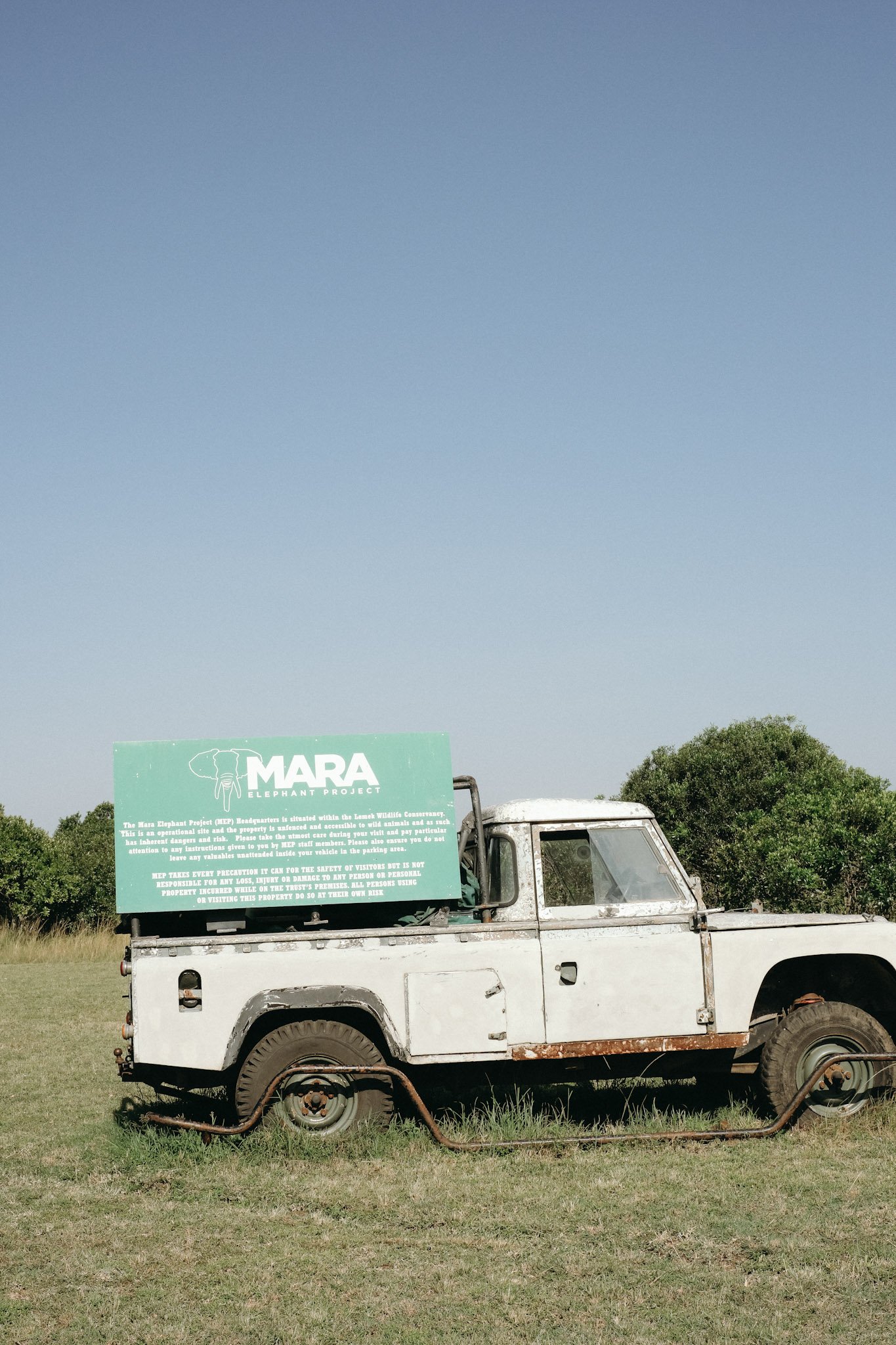
MARA ELEPHANT PROJECT
Leading the herd on conservation innovation
Written By Phoebe Richmond, Co-Founder
Photography By Alice Armitage
October 2026

In June, I visited Mara Elephant Project to learn about the work behind protecting elephants in the Greater Mara ecosystem. We heard from the team about their work across the region, and came away struck by their passion, dedication and depth of knowledge.
We arrived to be greeted by Saleno Mparru, an operations officer who came to the project in 2024, prior to that he was working on southern white rhino protection at Ol Choro Oirouwa Conservancy.
My impression was that Mara Elephant Project does nothing by halves. The detail behind their work, and the thought that goes into translating research into practical action, was evident throughout our visit. Their use of technology particularly impressed me, and you can see the influence of some of the board members' tech backgrounds.
Founded in 2011, the organisation now has a cohort of more than 100 Kenyan rangers and researchers, working with Kenya Wildlife Service, the Wildlife Research and Training Institute, Narok County and the conservancies.
On safari, we see elephants moving through the landscape. What is less obvious is the network of people, research and daily monitoring that keeps them safe as they move between wildlife habitat, farms, settlements and borders.

From tracking to action
During our visit, the team explained how they monitor collared elephants' activity and know when one is approaching a township, a farm or border. The system flags it on managers' phones, and a ranger unit is sent the coordinates to turn the herd before an encounter becomes dangerous. If a collar stops moving altogether, a different alarm sounds, because the elephant may be hurt.
The alerts come through EarthRanger, a conservation platform developed by Save the Elephants and the Allen Institute for AI. MEP runs it across the Mara, and its research team continues to extend it. The collars themselves are fitted jointly by MEP, Kenya Wildlife Service and the Wildlife Research and Training Institute, who have collared more than 100 elephants since 2011, each chosen to speak for its herd. At night, MEP rangers follow up with nine drones, three with thermal cameras, and ease elephants out of farmland without anyone approaching on foot.
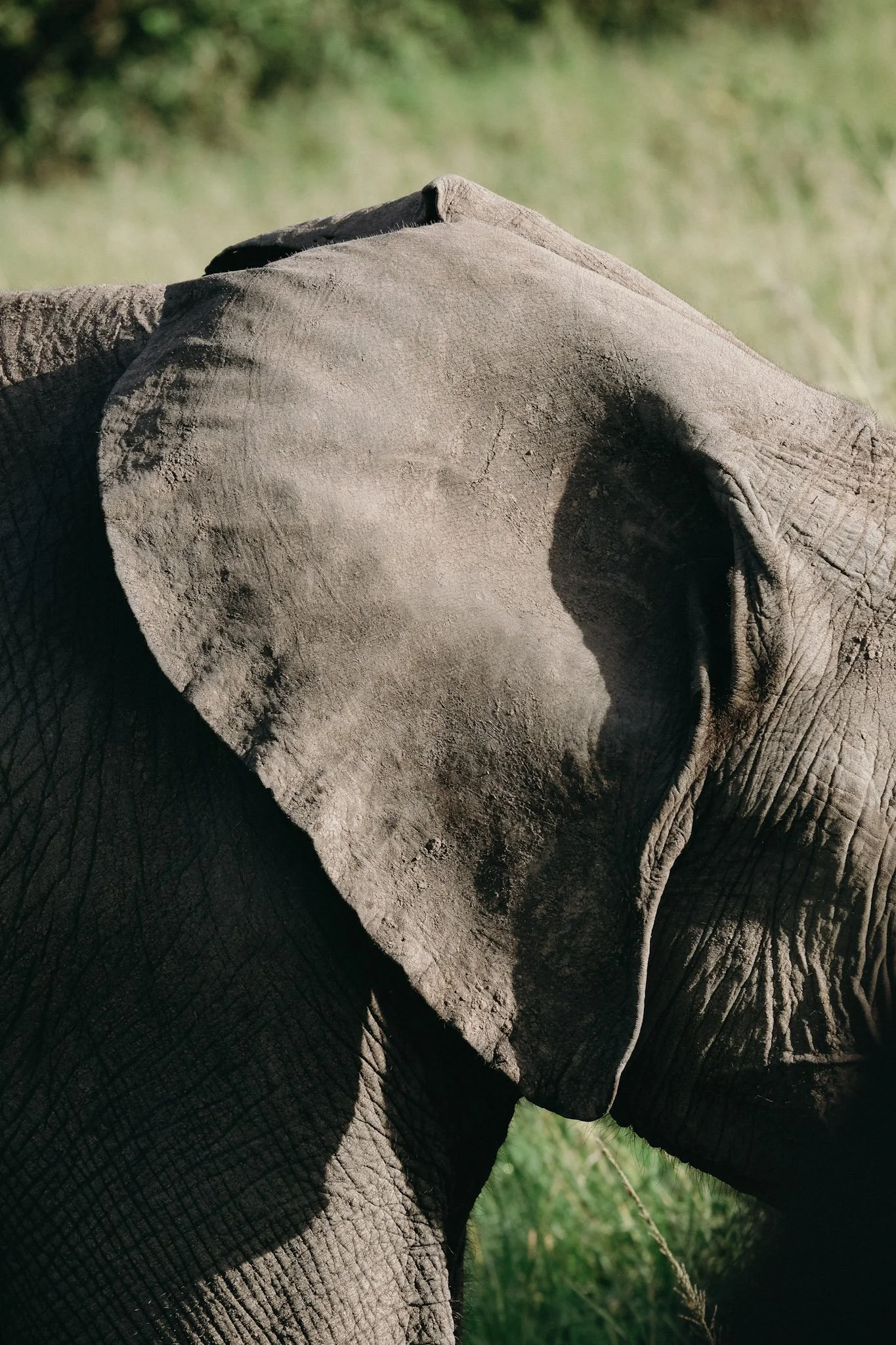
MEP's own research team has built further tools alongside partners. The most striking is ElephantBook, made with the California Institute of Technology and Elephants Alive. An elephant's ears are as individual as fingerprints, and the software matches photographs of them to identify each animal; almost half of the Mara's roughly 2,600 elephants now have an ID. Other tools map the fences spreading across the landscape, and turn months of data analysis into a matter of hours.
What stayed with me was how directly the technology connects to action. An elephant approaching a farm is more than a moving point on a screen. It may signal a risk to someone's crops, livelihood or safety, as well as to the elephant itself.
The team showed us the EarthRanger map, and it brought all of this together. The whole ecosystem sits on a single screen, with each collared elephant's recent path traced across a base map of fences, farms and settlements. Seeing those paths weave between the farmland made the challenge of sharing this landscape clearer than any statistic could.
When a collared elephant approaches a digital boundary drawn around a township, a farm or a reserve edge, an alert reaches managers' phones.


From poachers to pastures
When MEP began, the threat carried a rifle. Across Africa, an elephant was being executed for its ivory every 15 minutes. In the Mara, ivory poaching has since fallen by 98%.
Today the danger looks more like a field of ripening crops. An elephant can strip a farm in a single night, and for the family relying on that harvest the loss is immediate. Fences, farms and townships are spreading across routes elephants have walked for generations, and conflict now claims more Mara elephants than poaching does. MEP's view is that everyone living beside elephants has a stake in protecting them, so the organisation has turned toward the farmers too.


In 1973, Kenya had about 167,000 elephants. By 1989, roughly 16,000 remained.
- 1977Kenya bans sport hunting.
- 1989President Moi burns 12 tonnes of ivory in Nairobi National Park.
- 2013A new wildlife law brings life sentences for poaching endangered species.
- 2016105 tonnes burned on the same spot, the largest ivory burn on record.
- 202136,280 elephants counted, more than double the 1989 low.
Kenya sets the ivory industry alight
In 1973, Kenya had around 167,000 elephants. By 1989, fewer than one in ten remained. That July, President Daniel arap Moi set fire to 12 tonnes of ivory in Nairobi National Park, a public declaration that Kenya would not profit from the trade. Richard Leakey, newly in charge of the country's wildlife, followed with armed anti-poaching units authorised to shoot poachers on sight.
Kenya's stance has only hardened since. Sport hunting had already been banned in 1977, and a 2013 law made poaching an endangered species punishable by life imprisonment and fines of more than KSh 20 million. In 2016, the country returned to the same spot to burn 105 tonnes of ivory across 11 pyres, the largest burn on record. By 2021, the national census counted 36,280 elephants, more than twice the 1989 low.
Elsewhere, the picture is mixed. Next door in Tanzania, elephant numbers fell by around 60% between 2009 and 2014. Botswana, home to around a third of Africa's elephants, lifted its hunting ban in 2019, citing the toll on farmers, and has joined Namibia and Zimbabwe in arguing that regulated ivory sales could help pay for the cost of living alongside such large herds. Kenya holds that any legal trade only feeds demand.

The view from above
MEP's CEO, Marc Goss, flies the Mara's only helicopter dedicated to wildlife, a Robinson that MEP has operated since 2015. From above, a column of smoke turns out to be a charcoal kiln and a clearing turns out to be a poachers' camp, and the coordinates go down to rangers on the ground. On routine flights he checks on the collared herds, which between them represent 400 to 600 elephants.
Its flight log reads like the Mara's ambulance service. The helicopter has hovered over vets treating injured elephants, carried orphaned calves to the Sheldrick Trust nursery and flown a poisoned vulture to treatment. It has scattered seedballs over stripped forest, and flown out rangers and villagers who were too far from a road to reach a hospital.

A wider role in the Mara
Another side of the project that impressed me was its role when people are in danger. MEP keeps the helicopter, boats and rowing equipment ready through the rains, and its teams train in swift-water rescue.
On 1 May 2024, after a month of rain, the Talek River burst its banks and cut off 14 camps. The call came as the water rose. The helicopter flew for almost seven hours while ground teams roped guests across two at a time. Working with Kenya Red Cross, Narok County and local people, they brought 90 people out, and no one died on the Talek that day. In the days that followed, the helicopter dropped food to county rangers cut off from their base.
Elephants have needed rescuing too. In April 2020 the Mara River rose behind Fred, a collared bull, and he spent weeks stranded on its western bank. Two years earlier, MEP scouts pulled a calf no more than a week old from the flooded river. Sheldrick Wildlife Trust flew her to safety and named her Lemeki.
These operations show how much a trained, equipped team is worth in a remote landscape. The people and resources protecting wildlife are also part of the Mara's emergency response.

Looking more closely
Our visit gave a fuller picture of what it takes to protect elephants here. Alongside the fieldwork sits a considerable investment in research, technology, training and relationships with communities and partners.
The technology was particularly memorable, but its value lies in what the team does with it: recognise a risk, locate an animal, deploy rangers or help someone reach safety.
For those of us who visit the Mara, understanding this work adds depth to the experience. The landscape we come to see is also home to people making a living, raising families and managing life alongside wildlife.
To support the work directly, visit Mara Elephant Project.
Experience conservation beyond the game drive. Visit Mara Elephant Project as part of your tailor-made safari with Immersion Safaris.